The number nobody puts on the P&L
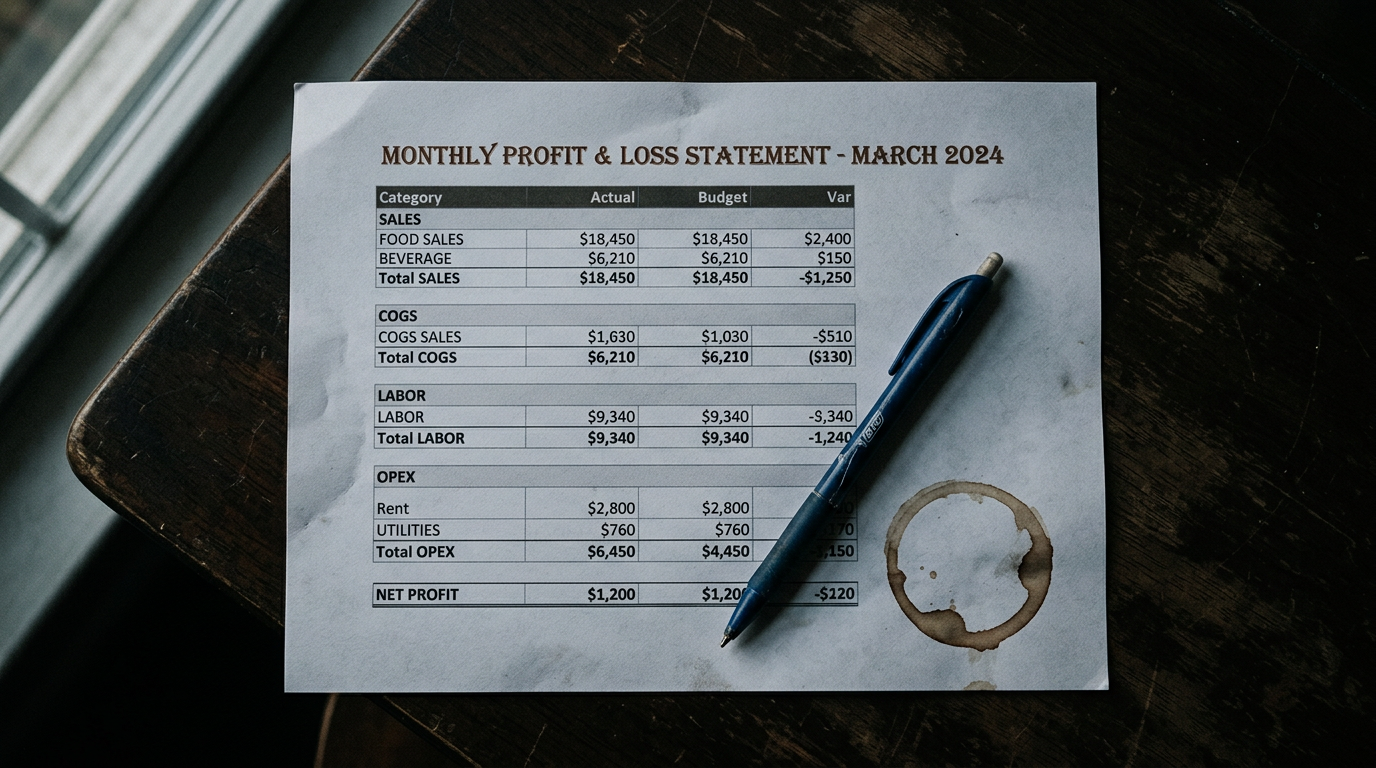
Owner's discretionary income. You won't find it on a standard restaurant P&L, but it's the only number that actually tells you whether you're building a business or doing the most expensive job you've ever had.
Here's how to get it: take your net profit, add back your owner's salary or draws, add back any non-cash expenses (depreciation, amortization), add back any one-time or discretionary expenses you ran through the business. That's your ODI.
For a lot of independent restaurants, this number is somewhere between $40,000 and $80,000 a year. After 70-hour weeks. After years of build. After the personal guarantee on the lease.
If you hired someone to do your job, what would you pay them? Probably $90,000 to $130,000, plus benefits. Which means in most cases, the restaurant is underwater on owner compensation before you even start counting the risk premium.
True labor burden isn't what's on the schedule
Restaurant operators who watch their labor cost are usually watching the wrong number. They're looking at hourly wages. They're not adding the full picture.
True labor burden includes: hourly wages, plus employer FICA (7.65% on every dollar), plus state unemployment insurance (varies wildly by state, but budget 2.7% as a starting point), plus workers' comp (in New York, that can run 4-8% of payroll depending on your claim history and job classifications), plus any employer-paid health benefits, plus paid sick leave where mandated.
In New York City, a $20/hour line cook costs you somewhere between $27 and $31 per hour all-in, depending on your specific rates. If you're scheduling 28 hours a week for that cook, you're spending $756 to $868 per week, not the $560 you might be tracking on your manager report.
That gap compounds. A 60-person restaurant running 4,200 scheduled labor hours a month could have a true labor burden 20-35% higher than what shows on the summary line. That's not a rounding error.
What your lease is actually costing you
Restaurant lease math is usually discussed as a percentage of revenue, and 8-10% is the target most operators have heard. That's not wrong, but it's incomplete.
Your occupancy cost isn't just base rent. It's base rent, plus CAM charges if applicable, plus real estate tax escalations, plus the amortized cost of your build-out (especially if you took a personal loan to cover what the landlord didn't build). And the percentage-of-revenue framing breaks down entirely when you're in a lease with heavy fixed costs and your revenue hasn't hit projection yet.
Better framing: what is the minimum monthly revenue you need to cover all fixed costs and have the ability to pay yourself something? That's your fixed cost floor. Every dollar below that floor costs you money out of pocket. Every dollar above it is where you actually start building a business.
For a 60-seat restaurant in a secondary Manhattan neighborhood (think Inwood, Kingsbridge, Sunnyside), that floor is often $85,000 to $110,000 a month. In a prime location with higher rent and more expensive build-out, it can be $160,000 or more before the economics start working.
The three-legged stool that actually works
Independent restaurants that survive past year five almost always have three things working in combination.
Food cost and labor cost together stay under 60% of revenue. Not each individually. Together, as a percentage of top-line. The mix can vary, but the combined number is the operating discipline.
They have a revenue source that doesn't depend entirely on covers. Private dining, catering, retail, branded product, event partnerships. Something. The fully table-dependent revenue model is fragile against seasonality, weather, delivery platform shifts, and now a dozen other variables that didn't exist ten years ago.
The owner understands the difference between cash flow and profitability. A restaurant can be profitable on paper and cash-poor in practice. Managing the timing of payables, the rhythm of payroll, the lag in credit card deposits, the tax reserve, all of that is a separate discipline from reading the P&L.
Start here
Pull your last 12 months of P&L. Calculate your ODI. Calculate your true labor burden for one pay period. Calculate your fixed cost floor.
If those three numbers are clear, every other decision gets easier. If they're not clear, nothing else you optimize actually matters.
You can have great food, a loyal following, and a full room on weekends, and still be slowly going broke. The math doesn't care about your Yelp rating.