The number most operators hear
Ask any lawyer who does SLA work about the timeline and they'll say 90-120 days. That number is not a lie. It's the SLA's own published processing target, and it's achievable under specific conditions: a straightforward application with no community board objection, a clean record for all principals, an address without a prior license issue, and no errors in the initial filing.
For a significant portion of first-time applicants in New York City, none of those conditions apply simultaneously.
The community board layer
Before the SLA processes a license application in New York City, the relevant community board gets a 30-day review period. This is not optional. It's a required step. And the community board's response ranges from silent non-opposition (best case) to a formal denial recommendation (worst case), with a lot of territory in between.
In neighborhoods that have adopted density caps for liquor licenses, the community board process is adversarial. Community Board 3 (covering the East Village, Lower East Side, and Chinatown) has been one of the more active boards in opposing new on-premise licenses in the last decade. Parts of Community Board 7 and CB9 in Brooklyn have done the same. If your space is in a district with an active CB position against new licenses, you need to know that before you sign the lease, not after.
A community board denial recommendation doesn't automatically kill your license. The SLA can and does override CB recommendations. But it complicates the process, extends the timeline, and in some cases requires a personal appearance before the SLA Authority Members, which adds another 60-90 days minimum.
The application itself
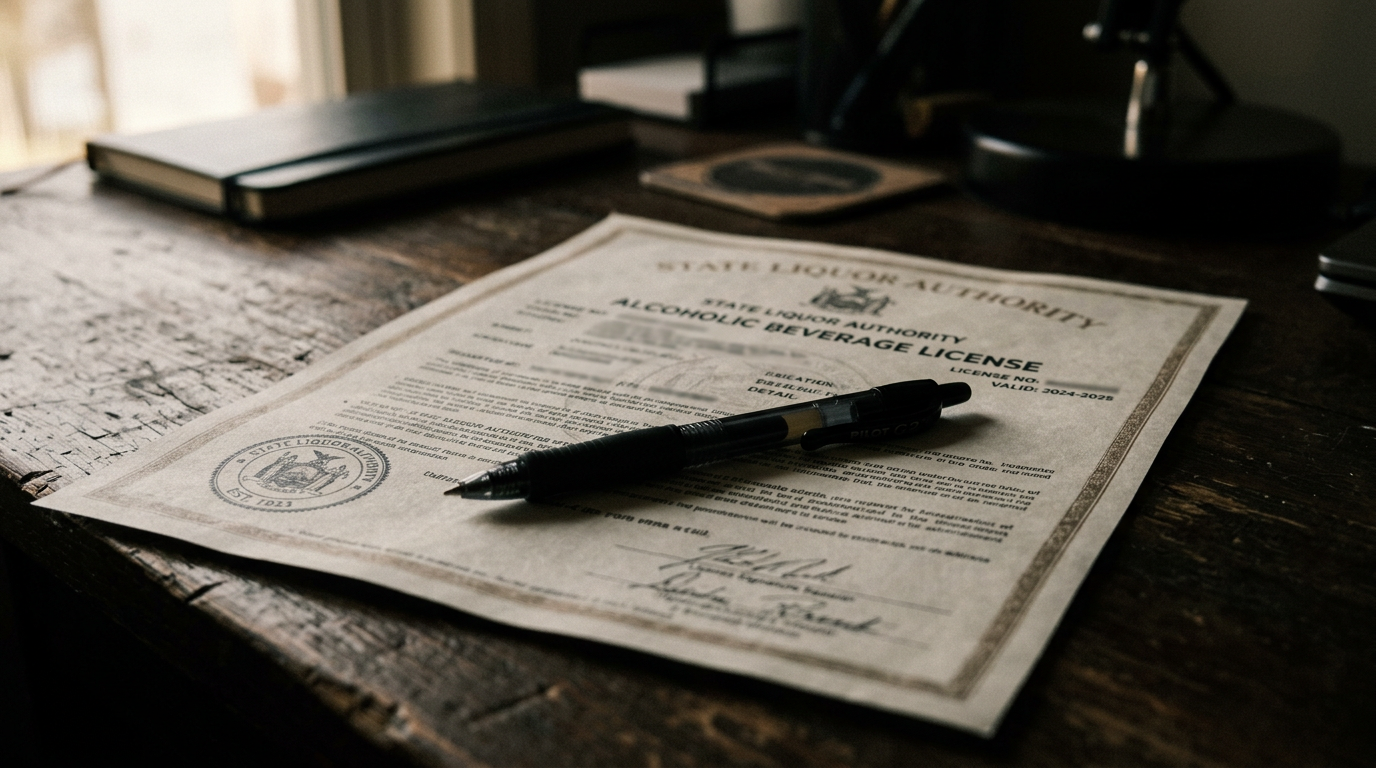
The SLA application for a new on-premise license (which covers full liquor for a restaurant, as opposed to beer-and-wine) requires:
A detailed floor plan of the licensed premises, stamped by a licensed architect or engineer. A Certificate of Authority from the Department of State for the business entity. A lease or proof of leasehold interest. Personal histories for every principal with 10% or more ownership, including a background disclosure and fingerprinting through the SLA's vendor.
Common filing errors that restart the clock: wrong entity type listed (LLC vs. Inc.), floor plan that doesn't match the DOB-approved plans, lease that lists a different square footage than the application, missing information on a principal's background disclosure.
An experienced SLA attorney or expediter who reviews the application before filing catches most of these. Doing it yourself to save money usually costs more time than the attorney fee.
The temporary retail permit
Here's something many first-time applicants don't know: the SLA has a Temporary Retail Permit process that allows you to operate with a limited license while your full application is pending, under specific conditions.
The TRP is not automatic. It requires the full application to be on file, the space to have passed a DOH pre-operational inspection, and no active community board opposition. When it works, it allows you to open and generate revenue while waiting for the full license to process.
When it doesn't work, or when it gets held up in SLA's own processing backlog, you're sitting on a built-out restaurant you can't open. The carrying costs in this window are significant. One restaurant I worked with spent $85,000 in carrying costs waiting for a TRP that kept getting delayed.
What you can control
Start early. The SLA application should go in as soon as you have a signed lease and an entity formed. Do not wait for construction to finish. The 90-120 day clock starts when you file, not when you're ready to open.
Hire someone who knows the system. A lawyer or expediter who does SLA work exclusively, not a general business attorney who does occasional SLA work. The difference in processing efficiency is significant.
Research your community board before signing. The CB's liquor license positions, meeting minutes, and any active density policies are public record. Know what you're walking into before you're committed.
Overcapitalize for the TRP gap. Build at minimum 90 days of additional carrying costs into your pre-opening capital budget on the assumption that the license takes longer than projected. If it comes in on schedule, you keep the money. If it doesn't, you don't lose the restaurant.
The honest framing
The SLA process is bureaucratic, slow, and occasionally arbitrary. It's also navigable. The operators who get through it fastest are the ones who go in with professional help, complete applications, and realistic timelines. The ones who get crushed by it are usually the ones who believed the 90-day number and planned accordingly.